
close
Choose Your Site
Global
Social Media

Views: 0 Author: Site Editor Publish Time: 2026-01-08 Origin: Site
When it comes to precision in construction, surveying, and other engineering projects, accuracy is paramount. The 5 Lines Rotary Laser Level is a tool widely used in these fields to ensure that surfaces are perfectly level and measurements are precise. But how accurate is this tool, and how can you ensure the best results? In this article, we will break down what "accuracy" means for a 5 Lines Rotary Laser Level, discuss the factors that affect its performance, and explain how this tool compares to others on the market.
The accuracy of a 5 Lines Rotary Laser Level is a critical consideration for professionals who rely on precision in their work. Let’s dive into what "accuracy" means in practical terms and the standard error margins for this tool.
The accuracy of a 5 Lines Rotary Laser Level is usually indicated by a specification such as ±1mm, ±2mm, or more. This means that the tool is expected to be within that margin of error when measuring distances. For example, a laser level with an accuracy of ±1mm means that any measurement taken by the device will be within 1mm of the actual distance.
Accuracy is not only about how precise the laser level is but also how reliable it is over time and in various environments. Laser levels with high accuracy are essential in fields like construction, where even small errors can lead to significant issues in alignment and leveling.
The 5 Lines Rotary Laser Level typically features an accuracy range of ±1mm to ±3mm. For short distances (up to 20 meters), the accuracy is usually higher, with most models offering ±1mm accuracy. As the distance increases, especially when measuring over 50 meters, the accuracy margin may widen, generally around ±2mm to ±3mm, depending on the specific tool and environmental factors.
The measurement range also plays a role in determining the overall accuracy. A 5 Lines Rotary Laser Level with a range of 100 meters or more may have a slightly larger margin of error than a model with a shorter range, but it will still provide reliable results for large-scale projects.
While the accuracy of a 5 Lines Rotary Laser Level is generally impressive, several external factors can impact its performance in the field.
The material of the surface you are measuring is a critical factor in the tool’s accuracy. Reflective surfaces, such as glass or polished metal, can cause the laser to scatter, resulting in inaccurate readings. Conversely, darker or matte surfaces may absorb some of the laser’s energy, making the reflection weaker and possibly affecting the measurement.
Additionally, the distance between the laser and the target surface is a key element. At longer distances, small deviations in the angle or alignment of the laser can result in larger errors in the final measurement. It’s important to ensure that the target surface is flat, stable, and properly aligned with the laser level for optimal performance.
Bright sunlight can also reduce the effectiveness of the laser, especially in outdoor environments. In such conditions, the laser beam may be less visible, making it difficult to aim and align the tool accurately. However, many 5 Lines Rotary Laser Levels come equipped with enhanced visibility features or detectors to mitigate this issue. Laser detectors help you monitor the beam in bright light, ensuring that the measurement remains precise even under challenging conditions.
The angle at which the 5 Lines Rotary Laser Level is positioned can affect the accuracy of the projection. If the device is tilted, even slightly, the projected lines may not align perfectly, leading to measurement errors. Most models come with built-in leveling features, such as bubble vials or electronic self-leveling systems, to help you maintain the correct angle and ensure accurate projections.
The 5 Lines Rotary Laser Level excels in a variety of tasks, but its accuracy can vary based on the scale and type of work you’re doing. Let’s look at some common scenarios where this tool is used.
For smaller, interior tasks such as leveling a floor, installing cabinets, or hanging pictures, a 5 Lines Rotary Laser Level provides excellent accuracy. Typically, you can expect ±1mm to ±2mm of accuracy when working in smaller spaces or over shorter distances. For such tasks, the 5 Lines Rotary Laser Level offers more than enough precision to ensure that everything is perfectly aligned.
When it comes to large-scale outdoor projects like site grading, landscaping, or laying the foundation for a building, the accuracy of the 5 Lines Rotary Laser Level is still impressive. However, the distance between the tool and the target surface can lead to a slight increase in the margin of error. In these cases, it’s common to see a range of ±2mm to ±3mm accuracy, depending on the conditions. This is still highly accurate for large outdoor spaces where precise leveling is crucial.
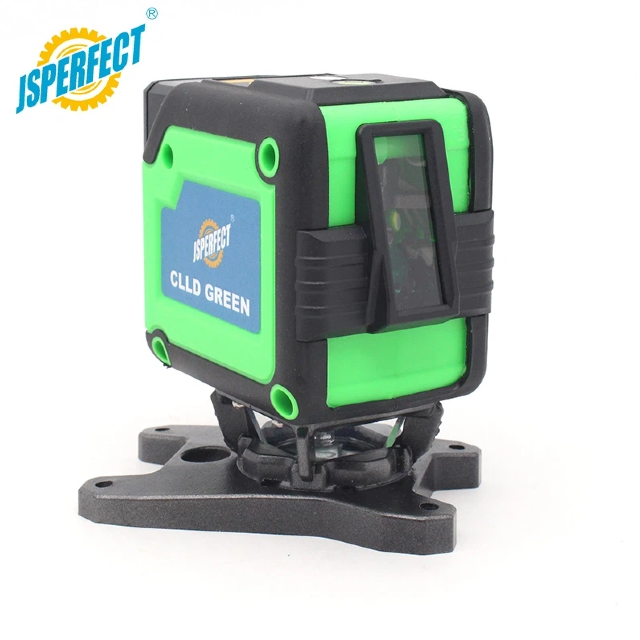
To get the best results from your 5 Lines Rotary Laser Level, there are several tools and techniques you can use to improve accuracy, especially in challenging environments.
Stability is key when using a 5 Lines Rotary Laser Level. A sturdy tripod or mount helps ensure that the laser is perfectly still during measurements. Even slight movements or vibrations can lead to inaccuracies, especially in sensitive measurements. Using a high-quality tripod or mount will help maintain the tool’s alignment, ensuring precise results.
As mentioned earlier, bright outdoor lighting can affect the performance of the laser. To counteract this, using a laser detector is essential. Laser detectors amplify the laser beam, allowing you to detect the beam even in bright sunlight. This feature is particularly useful when working on large outdoor projects, where the laser beam may be difficult to see with the naked eye.
When choosing a laser level, it’s important to compare the accuracy of a 5 Lines Rotary Laser Level with other types of laser tools to determine which is best suited for your needs.
Feature | 5 Lines Rotary Laser Level | Cross-Line Laser Level | Dot Laser Level |
Number of Laser Lines | 5 (horizontal and vertical) | 2 (horizontal and vertical) | 1 (point reference) |
Applications | Large projects, site grading, construction | Small to medium indoor tasks | Small, localized tasks |
Accuracy | ±1mm to ±3mm | ±2mm to ±3mm | ±3mm to ±5mm |
Range | Up to 100m+ (with detector) | Up to 30m | Up to 20m |
Best for | Large-scale construction, surveying | Home renovation, furniture alignment | Spot measurements, quick checks |
When deciding between a 5 Lines Rotary Laser Level and a cross-line laser or 3-plane model, the decision comes down to the scope and scale of your project. A 5 Lines Rotary Laser Level is ideal for large-scale, professional projects that require precise alignment in multiple directions. A cross-line laser or 3-plane laser may suffice for smaller indoor tasks where only two or three planes need to be aligned.
Professional 5 Lines Rotary Laser Levels tend to offer higher accuracy, longer range, and more durable construction compared to budget models. While budget models may be suitable for basic indoor projects, professional-grade tools are designed for demanding environments and large-scale applications, offering superior performance and reliability.
The accuracy of a 5 Lines Rotary Laser Level is crucial to the success of any project, whether it’s a small interior renovation or a large outdoor construction job. By understanding the factors that affect accuracy, you can ensure that your laser level is used correctly and that your measurements are precise. Whether you’re working on a small home project or a large commercial job, a 5 Lines Rotary Laser Level offers the accuracy you need to get the job done right.
At JSPERFECT, we offer high-quality Laser Levels, including the 5 Lines Rotary Laser Level, designed to meet the needs of both professionals and DIY enthusiasts. If you’re looking for a tool that guarantees accuracy and reliability, don’t hesitate to contact us today.
How accurate is a 5 Lines Rotary Laser Level?
A 5 Lines Rotary Laser Level is typically accurate within ±1mm to ±3mm, depending on the model and application.
Can I use a 5 Lines Rotary Laser Level for outdoor projects?
Yes, it’s ideal for outdoor tasks such as site grading and landscaping, with optional laser detectors to improve visibility in bright sunlight.
How do I improve the accuracy of my rotary laser?
Use a stable tripod or mount and consider using a laser detector for outdoor applications to improve accuracy and visibility.
What is the difference between a rotary laser and a cross-line laser?
A rotary laser projects multiple lines in 360° for large-scale projects, while a cross-line laser typically projects two intersecting lines for smaller tasks.


