close
Choose Your Site
Global
Social Media

Views: 0 Author: Site Editor Publish Time: 2026-05-18 Origin: Site
Traditional floor layout methods often rely on chalk lines, manual builder's squares, and physical spirit levels. Unfortunately, these outdated tools consistently introduce human error into the workspace. A small miscalculation compounds over large surface areas. This ultimately drives up expensive rework costs and delays project schedules. Modern flooring materials, such as large format natural stone or luxury vinyl planks, leave no room for guesswork.
Transitioning to a verifiable, data-driven workflow changes everything. A 4D Laser Level turns manual estimation into a highly precise science. This transition guarantees your reference lines remain absolutely perfect from the first tile to the last plank.
This article provides a standardized, professional-grade framework for modern flooring contractors. You will discover exactly how to establish accurate floor heights and map subfloor inconsistencies. We will also detail how to execute complex layouts with zero margin for alignment errors. Master these techniques, and you will elevate your floor installation process to an entirely new standard.
Dual-Purpose Functionality: Floor installations require a laser level for two distinct mandates—determining accurate level height (grading) and confirming exact material layout (squaring).
The 4D "Bottom Line" Advantage: The lowest horizontal beam allows installers to use lightweight, low-profile positioning jigs (½ to ¾ inch) rather than bulky 3-to-4-inch alternatives.
Error Prevention: Verifying auto-leveling stabilization and conducting mandatory 6-to-12-month calibration checks are non-negotiable steps to prevent compounding installation errors.
Versatility: Beyond standard tiles, 4D lasers are critical for finding absolute true square in large format (12x24) tile setups and complex Herringbone laminate patterns.
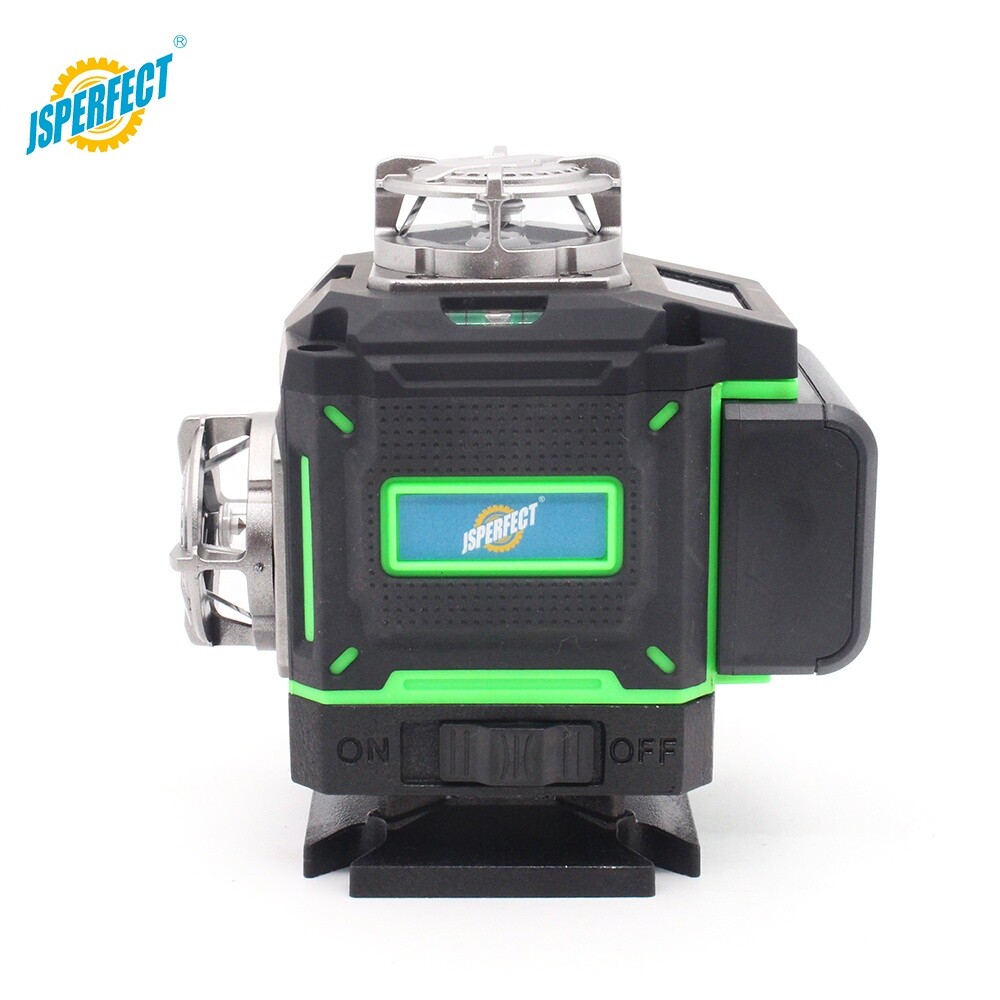
Many professionals express skepticism around the terminology of 16-line lasers. Some view it as a mere marketing gimmick designed to sell more expensive tools. However, the fourth plane represents a highly practical feature. It produces a bottom-most horizontal line. This specific low-clearance projection hovers mere millimeters above the subfloor. It is essential for efficient floor work.
Projecting a beam this close to the ground transforms your tooling requirements completely. Workers can now use significantly thinner, more accurate measuring jigs. You can switch to ½-inch leveling clips. You no longer need bulky 3-inch clearance alternatives. This keeps your measurement references as close to the actual working surface as possible. It prevents parallax errors caused by reading a mark too high off the ground.
Furthermore, these units offer true omnidirectional coverage. Four separate 360-degree laser planes project a comprehensive grid across the entire room. You never need to physically reposition the unit. Moving a laser mid-job risks losing your established reference point. A full 16-line grid eliminates this danger entirely. You lock the unit down once and work freely.
Integrated smart features act as massive productivity multipliers for solo contractors. Bluetooth app controls and automatic sensor modes streamline solo workflows. Electric micro-adjust bases let you fine-tune the beam without touching the unit. You can use a remote to shift a vertical line a fraction of an inch across a fifty-foot room. You reduce manual transit time across large job sites significantly.
Floor installations demand two distinct operational mandates. First, you must establish accurate heights across uneven slabs. Second, you must execute precise material layouts to keep joints straight. A 4D Laser Level handles both objectives simultaneously.
You cannot install premium flooring on a compromised subfloor. The device utilizes an internal pendulum. It also features a magnetic damping system. These components work together to find absolute zero instantly.
You must map structural high and low points directly on the subfloor. Mark these inconsistencies clearly before you pour self-leveling compounds. Many installers set depth pins across the floor based on the laser beam. This step is also critical before installing rigid underlayments. Knowing your exact floor topography prevents hollow spots. It stops structural failures before they begin.
Forget the traditional manual 3-4-5 triangle calculations. Physical tape measuring introduces slack and human error. Intersected laser crosshairs replace this outdated method entirely. This technology finds the absolute square of any room in seconds.
You can easily establish the exact starting point for full tiles in the center of the room. You project the beam to the opposite walls. This ensures your edge cuts remain symmetrical along all wall perimeters. Symmetrical perimeter cuts instantly elevate the visual professionalism of the finished space. They hide the fact that most residential rooms are not perfectly square.
Laser Level Functional Mandates | |||
Operational Mandate | Primary Goal | Traditional Method | Laser Level Advantage |
|---|---|---|---|
Subfloor Grading | Establish flat baseline | Manual spirit level, long straight edge | Magnetic damping finds absolute zero instantly |
Material Layout | Find true square | 3-4-5 tape measure calculations | Intersecting 360-degree crosshairs |
Height Validation | Verify pour depth | Guesswork or physical string lines | Precise alignment with leveling pins |
We rely on a standardized 5-step workflow for all hard surface installations. This operational procedure prevents baseline deviation. It maintains exact alignment from the initial prep phase to the final tile placement.
Step 1: Environmental Prep & Stabilization. First, clear your line of sight of all construction debris. Sweeping the floor removes obstacles. You must mount the device on a heavy-duty tripod, a lifting base, or a magnetic bracket. This isolates the sensitive internal pendulum from floor vibrations caused by heavy foot traffic.
Step 2: Auto-Leveling Engagement. Carefully unlock the pendulum system. You must allow the device to fully stabilize before making a single mark. Wait until the beam stops flashing. Working prematurely while the beam still bounces is a primary cause of baseline deviation.
Step 3: Establishing Reference Marks. Use a grade stick or a highly visible target plate. Mark your reference heights along the perimeter walls. Cross-reference multiple points around the room. This ensures the subfloor is structurally sound and mathematically flat across all corners.
Step 4: Grid Casting for Alignment. Project the central crosshair grid for your specific tile or wood layout. Align the vertical line directly against the primary focal wall. This verifies wall straightness. Adjust your layout baseline accordingly if the wall bows inward or outward.
Step 5: Multi-Point Verification. Continuously rely on the projected beams as you work. You must maintain perfectly straight rows as the installation progresses away from the center point. Do not turn the unit off. Check your alignment every few rows to guarantee zero drift.
Modern flooring materials demand extremely tight tolerances. Complex patterns and large format materials expose slight misalignments instantly. You need unshakeable reference lines to successfully execute these premium installations.
Large format tiles pose unique structural challenges. Even a millimeter of deviation causes noticeable lippage between adjacent tiles. Lippage refers to uneven edge heights. This creates severe tripping hazards and unsightly shadows under room lighting.
A laser grid prevents this completely. Installers pair the beam with modern tile leveling clips. The laser ensures the initial layout line is perfectly mathematically straight. The incredible precision of a 4D Laser Level provides a flawless foundation row. Your subsequent rows simply lock into place flawlessly without forcing joints.
Highly directional patterns require precise centerline tracking. Herringbone wood floors look terrible if the central axis drifts even slightly. The intricate interlocking 45-degree angles rely entirely on a perfectly straight starting point.
Traditional chalk lines blur easily. They fade quickly under foot traffic. Sometimes they snap inaccurately over debris. In contrast, brilliant green laser lines provide a constant, unmoving reference. They ensure perfectly straight rows over extremely long spans. You receive real-time visual confirmation before you nail or glue down a single plank.
Even the most advanced tools fail if contractors mishandle them. Proper implementation strategies and consistent maintenance routines preserve device accuracy. Follow these guidelines to protect your investment.
Failing to lock the pendulum: You must engage the pendulum lock during transport. Transporting an unlocked unit violently shakes the delicate internal components. This permanently destroys the internal calibration.
Placing the unit on unstable subflooring: Wood subfloors often flex under body weight. Installation impacts trigger micro-shifts in the laser line. Rubber mallet strikes on tile send shockwaves through the floor. Always mount your device securely on an isolated tripod to protect the beam from bouncing.
Ignoring temperature acclimation: Taking a cold laser out of a winter truck and placing it in a heated room causes condensation. Moisture fogs the internal prisms. Let the tool acclimate to room temperature before turning it on.
Lens Care: Construction sites are incredibly dusty environments. Dust particles, dry thinset residue, and finger smudges quickly coat the laser projection glass. This causes the laser beam to distort, widen, and lose crispness. You must mandate daily cleaning. Only use a chemical-free microfiber cloth to gently wipe the glass housings.
Calibration Cadence: Accuracy drifts naturally over time due to minor bumps on the job site. Institute a strict policy of monthly in-house calibration checks. Compare the beam against a known water level mark. Additionally, schedule a formal recalibration by a professional every 6 to 12 months. This maintains absolute spec tolerances.
A highly visible, omnidirectional setup completely shifts how we approach flooring projects. It turns an error-prone manual task into a precise, highly scalable operation. You eliminate costly rework entirely. You drastically speed up the critical layout phase.
We highly encourage contractors to assess their specific tooling ecosystems closely. Consider your requirement for advanced electric micro-adjust bases. Evaluate your specific working ranges when shortlisting your next 16-line unit. Upgrading your layout tools remains the fastest path to flawless, profitable flooring installations.
A: It projects a beam extremely close to the ground, allowing installers to use much smaller (½ to ¾ inch) layout jigs instead of bulky traditional clearance tools.
A: While standard interior 4D line lasers cover typical residential rooms efficiently (often up to 100-150 feet with a detector), high-end rotary lasers used for large commercial concrete slabs or exterior grading can reach 1,000 to 1,200 feet.
A: Industry best practice dictates monthly or quarterly manual checks against a known level mark, with professional servicing every 6 to 12 months.
A: Yes. Unlike chalk lines, laser beams do not smudge, cannot be swept away, and provide constant, real-time alignment verification throughout the entire installation process.