close
Choose Your Site
Global
Social Media

Views: 0 Author: Site Editor Publish Time: 2026-06-04 Origin: Site
A misaligned layout doesn't just cost materials. It destroys labor budgets and delays subsequent trades. One simple framing error often cascades through an entire build. Rectifying these foundational mistakes pulls your best workers away from critical path tasks. The market currently overflows with consumer-grade laser tools marketed heavily as "pro." For contractors, evaluating a Laser Level requires looking past basic marketing jargon. You must rigorously focus on jobsite survivability. You also need true accuracy over distance and maximized workflow efficiency. Relying on an inferior alignment tool creates hidden risks your business simply cannot afford. This guide breaks down the non-negotiable specifications required for professional-grade layout work. You will learn how to identify robust diodes and demand verified precision tolerances. We will show you how to select rugged, long-lasting battery ecosystems. Our actionable insights ensure your next equipment upgrade delivers immediate jobsite value.
Table of Contents
Green beams offer 4x the visibility of red beams but require larger battery capacities.
Pendulum locks are mandatory to prevent diode damage during transit.
Pulse mode/detector compatibility is the only reliable way to use a laser level outdoors.
IP54 ratings (minimum) are necessary to survive drywall dust and light rain.
Long-term ROI depends heavily on calibration services and warranty support, not just the initial purchase price.
Inaccurate alignments bleed your project margins dry. Consider a seemingly minor quarter-inch error stretched over thirty feet. This small deviation compounds rapidly into massive structural alignment issues. Your finish carpenters will struggle to install custom cabinetry. Drywall panels will not sit flush against skewed framing members. You ultimately lose days of productive labor correcting these foundational mistakes. Professional contractors cannot trust their reputation to sub-standard equipment.
Establishing clear success criteria mitigates these costly risks. A professional-grade unit must provide verifiable and consistent accuracy. It needs to resist severe environmental degradation. The equipment must seamlessly integrate into your existing power tool ecosystem. Tool integration minimizes frustrating downtime when battery power runs low. We consider these operational requirements the absolute baseline. You should quickly reject any tool failing these basic jobsite standards. True professionals demand reliable performance under harsh commercial conditions.
You cannot align what you cannot clearly see. Visibility and precise measurements form the foundation of layout work. We evaluate these core metrics before looking at any additional features. They directly dictate how efficiently your crews operate daily.
Green lasers stand as the undisputed standard for commercial interior work. Human eyes detect green light far better than red light. This biological advantage means green beams easily cut through bright ambient lighting. You will see green lines perfectly across large, brightly lit warehouse floors. Red beams often wash out completely in these demanding environments. We consider red units acceptable only for low-budget, low-light residential tasks.
This increased visibility carries a specific trade-off. Green diodes consume significantly more battery power. You must evaluate your intended power sources carefully. High-capacity battery platforms become essential when running green beams all day.
Green vs. Red Beam Comparison | ||
Specification | Green Beam | Red Beam |
|---|---|---|
Visibility Range | Up to 100 feet indoors | Up to 30 feet indoors |
Battery Consumption | High (requires robust packs) | Low (often runs on standard AA) |
Ideal Application | Commercial interiors, bright ambient light | Dim residential rooms, tight spaces |
Never purchase layout tools lacking a published accuracy rating. Precision remains the primary reason you use a Laser Level. Professional-grade minimums typically require ±1/8-inch accuracy at thirty feet. In metric terms, expect ±3mm at ten meters. Anything less accurate belongs in a DIY homeowner kit.
Temperature fluctuations easily compromise cheap internal diodes. Extreme heat or freezing cold causes internal materials to expand and contract. This thermal shifting permanently alters the baseline accuracy. You must seek thermally stable units built for harsh environments. Top-tier manufacturers build robust internal chassis structures specifically resisting thermal drift.
Direct sunlight rapidly renders any visible beam completely invisible. You simply cannot see a green line outdoors at noon. A dedicated pulse mode solves this exact visibility problem. Pulse mode flashes the beam rapidly at frequencies invisible to human eyes.
You pair this pulsing beam with an electronic receiver. The receiver detects the pulses and provides loud acoustic beeps. It also displays visual directional arrows indicating high or low alignments. This specific compatibility remains absolutely mandatory for exterior grading. You also need it for large concrete pours and extensive deck framing. Always confirm receiver compatibility before purchasing tools for outdoor projects.
When planning complex layouts, directional coverage determines jobsite speed. You want tools projecting references exactly where crews need them. Proper multi-plane coverage eliminates constant tool repositioning.
Internal gravity pendulums or electronic systems handle leveling. These mechanisms must settle quickly. Expect pro-grade units to lock on target within three to five seconds. Slow settling times waste minutes across a full workday.
Furthermore, out-of-level alerts provide critical safety nets. The unit must deliver an undeniable visual or audio warning. Flashing beams or loud beeps alert you immediately. The tool triggers these alerts when knocked out of its ±4° leveling range. Silent failures ruin entire layout grids before anyone notices.
To verify your self-leveling setup, follow these strict workflow steps:
Mount the unit securely to a heavy-duty surveyor tripod.
Unlock the internal pendulum to allow free movement.
Wait five seconds for internal mechanisms to completely stabilize.
Verify no flashing lines or warning beeps occur.
Mark your reference points across the required layout planes.
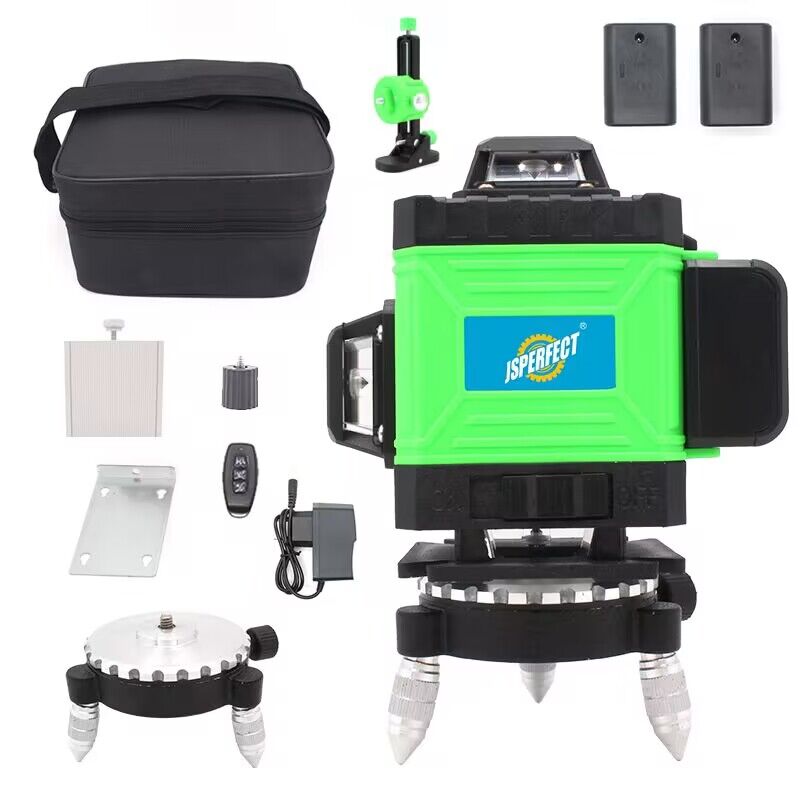
Evaluate your daily plane coverage requirements. Simple cross-line models project lines onto the front wall only. These work fine for basic tile backsplashes. However, complex jobs demand 3x360° simultaneous planes. These advanced tools project complete lines across the floor, the ceiling, and all four walls simultaneously.
Full 360-degree planes allow multiple trades to share one setup. Plumbers mark floor drains while electricians align ceiling tracks. Everyone works efficiently from the same perfectly leveled reference system. This capability significantly accelerates project timelines.
Intersecting ceiling lines sometimes grow blurry at extreme projection angles. Dedicated plumb dots solve this specific precision issue. They project concentrated laser spots directly upward and downward.
Framers use these dots for perfectly aligning top and bottom steel tracks. Plumbers rely on them transferring pipe penetrations from concrete floors to ceilings. Plumb spots remain significantly more precise and easier to mark than full intersecting lines. You avoid visual distortion entirely.
Construction environments destroy fragile consumer equipment daily. Dust, moisture, and impact damage constantly threaten sensitive internal prisms. Professional equipment must survive these harsh daily realities.
A free-floating internal pendulum swings violently during vehicle transport. It will completely destroy itself in the back of a bouncing work truck. Potholes and sudden stops shatter delicate glass prisms.
A mechanical lock serves as a strict prerequisite for tool longevity. It firmly secures the pendulum during transit. You also utilize this lock for secondary applications. Locking the beam allows you to project intentionally sloped lines. Contractors use this sloped mode for laying out stair rails or matching angled roof pitches.
Water and fine debris ruin unprotected electronics. You must evaluate the Ingress Protection (IP) rating. The absolute minimum acceptable standard is IP54. This basic rating ensures dust and splash resistance. It survives drywall sanding dust and light rain showers.
Heavy industrial applications require tougher standards. For heavy concrete or excavation work, demand IP65 ratings. Look for thick over-molded rubber housings surrounding the tool.
Here is a quick breakdown of common IP ratings for layout tools:
IP50: Offers basic dust protection. Fails instantly near moisture. Avoid for commercial use.
IP54: Resists drywall dust and splashing water. Excellent for indoor commercial finishing.
IP65: Completely dust-tight. Withstands direct water jets. Mandatory for exterior concrete work.
Disposable AA alkaline batteries represent a hidden tax on your business. They drain quickly and require constant replacement. Crews often halt production just to hunt for fresh batteries.
Look for units powered by high-capacity lithium-ion batteries. You should match the tool to your existing cordless tool platform. Brands like DeWalt, Milwaukee, and Makita offer native integration. You simply swap a standard 12V or 18V drill battery into your layout tool. This integration provides days of continuous runtime and eliminates battery-hunting downtime.
Initial purchase price rarely reflects the true value of professional layout equipment. You must evaluate long-term support infrastructure. Excellent tools inevitably face harsh drops or gradual calibration drift. How the manufacturer handles these realities determines your return on investment.
All measurement tools lose calibration over time. A single hard drop instantly misaligns the internal diodes. Before finalizing any purchase, verify the manufacturer's support network. Do they offer accessible recalibration services? Do they guarantee a fast service turnaround time?
You cannot afford to lose your primary layout tool for six weeks. Demand a minimum two-to-three-year warranty specifically covering premature diode failure. Professional brands stand firmly behind their internal components.
We designed a simple chart to help you shortlist the perfect equipment profile. Match your primary trade to the recommended technical specifications.
Equipment Shortlisting Chart by Trade | ||
Trade Profile | Recommended Beam Type | Priority Features |
|---|---|---|
General Framers | 3x360° Multi-line Green | Rugged battery platforms, mechanical pendulum locks |
Exterior / Concrete | Rotary Laser | High IP65 rating, long-range pulse receivers |
Electricians / Plumbers | Compact Cross-line | Dedicated plumb dots, strong magnetic mounts |
Upgrading to a professional-grade layout tool acts as an investment in risk mitigation. You immediately eliminate costly rework caused by skewed reference lines. We recommend you strictly prioritize beam visibility and verifiable accuracy. You must value mechanical durability over gimmicky software features. Robust equipment keeps your crews working efficiently under challenging conditions.
For your next step, audit your current cordless tool battery platform. Identify exactly which 12V or 18V batteries your crews use most often. Then, shortlist two or three compatible green-beam models carrying an IP54+ rating. Verify they include mechanical pendulum locks. This strategic approach ensures your next equipment purchase delivers relentless reliability.
A: Practically, no. Direct sunlight washes out even the brightest green diodes past a few feet. Ambient solar radiation simply overpowers the projected light. An electronic receiver or detector remains absolutely required for reliable outdoor work. It detects invisible pulses to ensure perfectly accurate exterior grading.
A: Standard industry practice is once a year. You must also recalibrate immediately after any significant drop or hard impact on the jobsite. Regular calibration checks ensure your foundational measurements remain strictly within manufacturer tolerances.
A: Cross-line lasers use stationary prisms to project lines. They remain ideal for indoor work up to 150 feet. Rotary lasers spin a single diode at high speeds to create a 360-degree plane. Manufacturers design rotaries primarily for long-range exterior grading and site prep up to 2,000 feet.
A: Yes, provided they utilize rare-earth neodymium magnets. Always test the mount on a clean steel stud or track. Dust or rust can easily compromise the grip. Ensure the mount includes both 1/4" and 5/8" tripod threads as a reliable mechanical backup.