close
Choose Your Site
Global
Social Media

Views: 0 Author: Site Editor Publish Time: 2026-05-18 Origin: Site
Scroll through any professional contractor forum, like r/Tools, and you will spot plenty of skepticism around the term "4D." Let us clear the air immediately. A 4D laser is not accessing a new dimension of physics. It is simply a clever marketing term for a highly practical tool: a 16-line laser level. Builders rely on accurate references to keep projects square and plumb.
Layout tools have evolved rapidly over the last decade. We moved from bulky rotary lasers to 3D, 12-line models. Now, we see 4D, 16-line systems dominating modern job sites. This rapid evolution leaves many tradespeople wondering if the upgrade is justified.
This article provides an objective, hype-free breakdown of how these devices function. You will learn where the extra laser plane actually drives real-world results. We will help you evaluate if your crew truly needs one. Read on to discover the specific trade applications where a 16-line model outperforms standard tools.
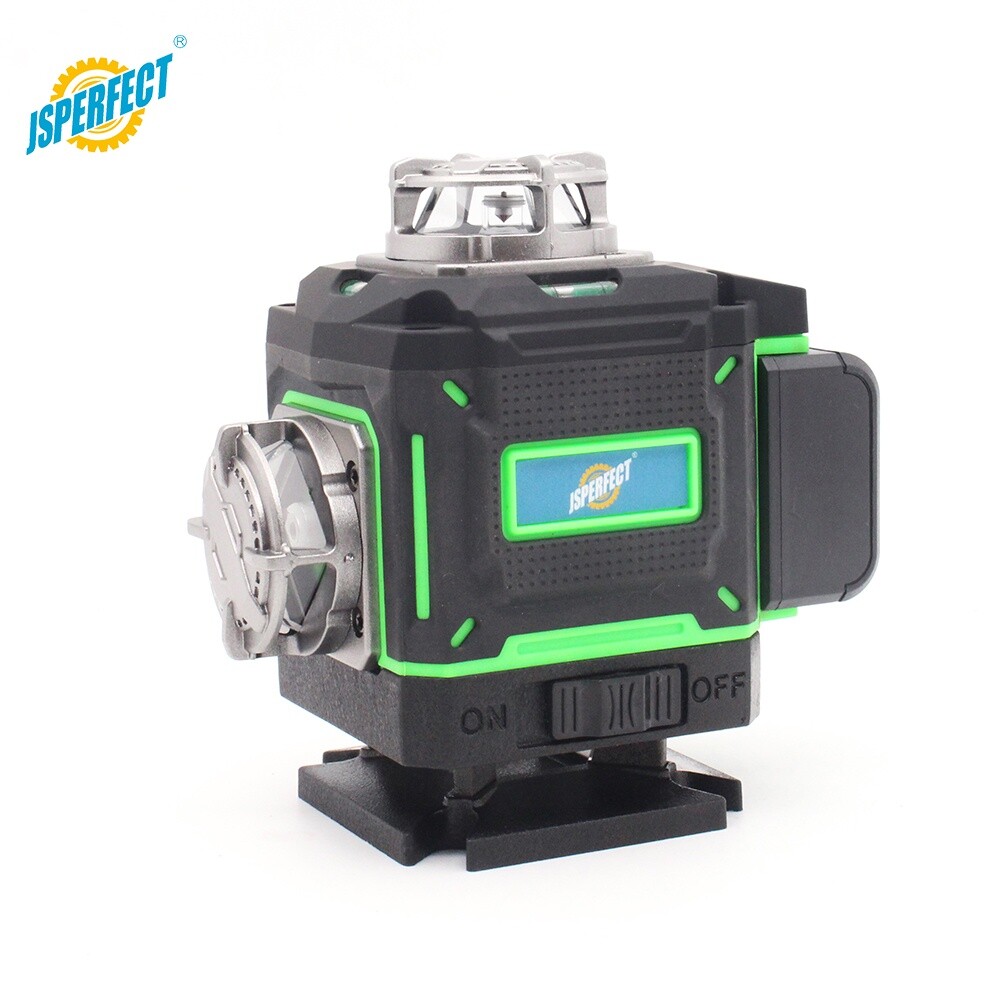
The "4D" Definition: A 4D laser level projects four independent 360-degree laser planes (two vertical, two horizontal), totaling 16 intersecting lines.
The Primary Advantage: The distinguishing feature of a 4D model over a 3D model is the additional bottom horizontal laser, designed specifically for low-clearance floor and tile work.
Evaluation Metric: Buying decisions should prioritize self-leveling pendulum accuracy, beam visibility (green diode), and IP-rated durability over sheer line count.
The Verdict: Highly recommended for flooring contractors, tile setters, and general contractors doing full-room layouts; potentially overkill for casual DIYers.
Tool manufacturers often use flashy jargon to sell equipment. You need to look past the marketing language to understand the mechanics. A 16-line unit relies on straightforward geometry.
The math is simple. The device houses four distinct laser diodes. Each diode projects a continuous 360-degree plane of light. Multiply four planes by 360 degrees, and you get 16 individual laser lines projected across your workspace. These beams paint the walls, floors, and ceilings simultaneously.
To understand the layout, we must identify the exact locations of these four planes on the device.
Top Horizontal Plane: Projects near the top of the housing. Contractors use this primarily for drop ceilings and high wall fixtures.
Bottom Horizontal Plane: Projects from the very base of the unit. This plane sweeps just above the subfloor.
First Vertical Plane: Projects forward and backward, establishing a primary plumb line.
Second Vertical Plane: Projects side to side, intersecting the first vertical plane at exactly 90 degrees.
Turn on all four planes, and you transform an empty room into a precise, visible blueprint. You create an immediate grid effect. The intersection of these laser planes creates exact 90-degree reference points. These points appear on all six surfaces of a standard room.
You can identify dead-center on the ceiling while perfectly aligning your floor track. You establish plumb and square lines without constantly repositioning the unit. This grid eliminates compound errors. When you set a corner perfectly, every subsequent measurement stays true to that initial reference.
Professionals often debate whether upgrading from a 12-line model makes sense. You must analyze your daily workflow to answer this question. A tool is only valuable if it solves a specific problem.
A standard 3D level features one top horizontal plane and two vertical planes. This configuration is highly capable. It handles roughly 85% of general construction tasks. Framers use it to plumb walls. Carpenters use it to hang cabinetry. Drywall crews rely on it for ceiling grids. For many general contractors, a 12-line unit feels complete.
We must focus purely on the lower horizontal beam. This bottom turret is the sole differentiator between the two formats.
Consider the implementation reality on a job site. If you only have a top horizontal beam, checking a floor-level line is tedious. You must take a tape measure, measure down from the laser line, and make a secondary physical mark on the wall. You repeat this every few feet.
A 4D Laser Level eliminates this manual step. It drops a bright beam within 1/4-inch to 3/8-inch of the actual subfloor. You instantly see high spots and low spots across the entire slab. You save hours of crawling on your knees.
Comparison: 3D vs. 4D Laser Capabilities | ||
Feature | 3D (12-Line) Laser Level | 4D (16-Line) Laser Level |
|---|---|---|
Horizontal Planes | 1 (Top only) | 2 (Top and Bottom) |
Floor Clearance | Requires manual tape drops | Sits 1/4" to 3/8" from subfloor |
Primary Use Case | Cabinets, framing, drywall | Flooring, tile, baseboards |
Setup Speed for Flooring | Moderate (Requires secondary marks) | Fast (Direct projection) |
You should not buy a 16-line model just to have the maximum number of lasers. You should upgrade only if your workflow demands it. High-frequency floor leveling justifies the purchase. Baseboard installation becomes incredibly fast. Tile setters and foundation crews will see immediate workflow improvements.
Understanding the hardware is only half the battle. You need to know exactly how to deploy it on the job site. The extra beam provides massive utility in specific scenarios.
Tile layout demands absolute perfection. Small alignment errors compound rapidly across a large room. The bottom beam allows for continuous checking of floor flatness. You do not have to move the unit. You project a tight grid directly over the subfloor or underlayment.
Checking Level: Sweep a ruler across the floor. Watch where the laser hits the ruler. The floor is dipping if the line drops. The floor is crowning if the line rises.
Grid Alignment: Use the intersecting vertical lines alongside the bottom horizontal. You create a perfect starting corner for large-format tiles.
Best Practice: Always position your 4D Laser Level in the center of the room for tile layouts. This minimizes beam spread and keeps the reference lines sharp across all edges.
Commercial work involves complex ceiling grids. You must install track flush against overhead joists. The top horizontal beam operates flush against the ceiling. Simultaneously, the bottom beam references the floor. You can instantly check if your ceiling layout perfectly matches your floor layout.
Framing crews love intersecting vertical lines. You can lay out steel or wood partitions flawlessly. The two vertical planes project intersecting crosshairs on the floor and the ceiling. You transfer points vertically without using a traditional plumb bob. This is excellent for aligning track lighting directly over a kitchen island.
The market is flooded with varying brands. You need a strict evaluation framework to avoid buying a substandard tool. Do not judge a unit simply by counting its laser turrets.
You must argue strictly for green lasers. Do not buy red lasers for a 16-line setup. Human eyes detect green light far better than red light. In fact, green is up to four times more visible to the human eye. A 16-line tool covers a massive area. You need maximum brightness to see lines against distant walls in well-lit rooms.
Precision is non-negotiable. Set strict baseline expectations. Look for an accuracy rating of at least ±1/9 inch at 33 feet. Beware of unbranded models. They often suffer from unacceptable drift. A cheap laser will cost you thousands of dollars in rework if it sets a crooked foundation.
A highly responsive smart pendulum system is mandatory. The internal pendulum uses gravity to find true plumb. Most quality units will auto-level if placed within 3 to 4 degrees of dead flat.
However, you also need a robust pendulum lock. This lock serves two vital purposes:
It secures the delicate diodes during transit. Unlocked pendulums bang against the housing and lose calibration.
It enables manual mode. You lock the pendulum to project angled lines, which is essential for laying out staircases or sloped drainage.
Evaluate battery life critically. Projecting 16 bright green lines drains batteries rapidly. A standard AA battery pack will fail quickly. We highly recommend models featuring high-capacity lithium-ion batteries. Look for dual-power options. Plug-in capability during use ensures your laser will not die in the middle of a critical layout.
Core Evaluation Metric Chart | ||
Evaluation Metric | Minimum Acceptable Standard | Premium Standard |
|---|---|---|
Diode Color | Green | High-Intensity Green (Osram Diode) |
Accuracy | ±1/9 inch at 33 feet | ±1/13 inch at 33 feet |
Pendulum | Auto-level within 4° | Fast settling time (<3s) + Lock |
Power | Rechargeable Li-ion | Swappable Li-ion + AC adapter |
Every tool has limitations. A 16-line system carries specific risks. You must manage your expectations and protect your equipment.
Notice the design of a 4D laser. It has four exposed glass turrets. More glass means a higher risk of job-site damage. A single drop from a tall tripod can shatter a turret. Always keep the unit in a padded hard case when not actively spinning lines.
Common Mistake: Leaving the laser set up in a high-traffic hallway during a lunch break. Workers carrying lumber easily knock over tripods. Always pack it away.
Calibration is a major pain point. Cheap, imported devices flooding Amazon often arrive out of calibration. Worse, they lack local service centers. If a premium brand loses calibration, you send it to an authorized center. If a cheap import drifts, it becomes a paperweight. Always verify the manufacturer offers recalibration services.
Manage your expectations regarding outdoor use. This is a crucial reality check. Even the brightest green lasers remain invisible in direct sunlight. You cannot visually align a driveway or a fence line at noon.
Outdoor functionality strictly requires a pulse mode feature. You must purchase a compatible laser receiver or detector. The detector beeps when it locates the invisible beam. Do not buy a laser for outdoor grading unless it explicitly supports pulse mode.
A 4D laser level is a specialized efficiency multiplier. It is not just a flashy upgrade. It fundamentally changes how you approach low-clearance tasks.
Keep these concise takeaways in mind:
Choose your units carefully. Base your decision on IP54+ water and dust resistance, verifiable accuracy specs, and robust mounting accessories. Avoid shopping based solely on the lowest price.
Magnetic brackets and micro-adjust bases are critical. They help you dial in exact alignments without fighting tripod legs.
Always lock the pendulum before placing the tool in your truck. This simple habit preserves calibration.
Assess your daily task list right now. If floor-level work isn't a daily requirement, a high-quality 3D unit might be the smarter investment. However, if flooring, tile, or baseboards dominate your schedule, the 16-line format is indispensable. Make your choice based on your actual job site demands.
A: No, it is strictly a manufacturer marketing term to indicate four 360° laser planes. Real-world physics involves 3 spatial dimensions; the "4th" here just means a 4th laser window.
A: Only if the unit features a "Pulse Mode" and you purchase a compatible laser receiver. Visual alignment alone will fail in direct sunlight.
A: This is the out-of-level alarm. It indicates the unit is positioned on a surface exceeding its auto-leveling range (usually >4 degrees). It must be adjusted on its tripod or shimmed to function.
A: Most use a standard 1/4"-20 or 5/8"-11 mounting thread, but for 4D models, a micro-adjust base or a tripod with a fine-tuning knob is highly recommended to precisely align the intersecting beams.