
close
Choose Your Site
Global
Social Media

Views: 0 Author: Site Editor Publish Time: 2026-04-23 Origin: Site
Choosing the right 16 Cross Lines Laser Level involves more than selecting a random model. These versatile tools project multiple intersecting lines across horizontal, vertical, and diagonal planes, delivering precision and efficiency for a wide range of projects. Ideal for both home renovations and professional construction, they ensure accurate alignment, leveling, and layouts without repeated manual measurements. With numerous models available, understanding technical specifications, laser visibility, power options, and accessory compatibility is essential. Making an informed choice helps you meet project needs, avoid unnecessary costs, and achieve reliable, long-lasting results.
When evaluating a 16 Cross Lines Laser Level, understanding its technical specifications is crucial for achieving accurate and efficient results. Three of the most important factors to consider are laser accuracy, laser color and visibility, and the power source. Each parameter directly affects the performance, suitability, and ease of use of the device, whether for home renovation, DIY projects, or professional construction tasks.
Laser accuracy determines how precise your measurements will be over a given distance. For detailed tasks such as tiling, cabinetry installation, or complex interior designs, even minor deviations can lead to significant errors, misalignment, or wasted materials. Accuracy ratings for cross lines laser levels typically range from ±1 mm/m to ±3 mm/m.
· ±1 mm/m Accuracy: This is the highest level of precision, often found in professional-grade laser levels. Such models are ideal for large-scale construction projects, high-end interior designs, or any task where perfect alignment is critical. Contractors and builders rely on this level of precision to ensure structural components, cabinetry, and decorative elements meet exact specifications.
· ±2 mm/m Accuracy: Suitable for home renovation and furniture installation, this level of accuracy balances precision and affordability. It is sufficient for most DIY tasks, including tiling walls or floors, installing shelves, and aligning frames or fixtures.
· ±3 mm/m Accuracy: Designed for general household or casual DIY projects, this accuracy level is adequate for simple alignment tasks, basic tiling, or hanging pictures and decorations. It allows users to complete tasks efficiently without the need for professional-grade precision.
Maintaining consistent laser accuracy is essential to ensure that walls, floors, and ceilings remain perfectly aligned without repeated adjustments, which saves both time and materials.
Laser color plays an important role in visibility under different lighting conditions. Cross lines laser levels are commonly available with red or green lasers, each offering distinct advantages.
· Green Lasers: Green beams are significantly more visible than red beams, especially in bright indoor lighting or partially outdoor environments. They are ideal for commercial sites, well-lit rooms, or construction areas where precision over long distances is required. The enhanced visibility reduces eye strain and improves alignment accuracy, making green lasers popular among professionals and advanced DIY enthusiasts.
· Red Lasers: Red beams are suitable for standard indoor projects, such as furniture installation, small renovations, or decorative work. They consume less battery power, are generally more affordable, and provide sufficient visibility for most home applications.
A laser level’s power source affects convenience, portability, and continuous operation. Most modern 16 cross lines laser levels use either rechargeable lithium-ion batteries or standard disposable batteries like AA or AAA cells.
· Rechargeable Batteries: Lithium-ion batteries offer longer continuous usage, faster charging, and cost savings over time. They are ideal for frequent use, professional projects, or tasks where reliable battery life is critical. Many models provide quick-charge capabilities, minimizing downtime between jobs.
· Disposable Batteries: These are convenient for occasional or emergency use. They can be quickly replaced on-site without the need for charging, making them practical in remote locations or when access to power is limited.
Feature | Recommended Use |
±1 mm/m Accuracy | Professional construction, precise tiling, complex interior designs |
±2 mm/m Accuracy | Home renovations, furniture installation, standard tiling |
±3 mm/m Accuracy | General DIY projects, basic alignment tasks |
Green Laser | Bright rooms, commercial projects, outdoor use |
Red Laser | Standard indoor DIY and renovation projects |
By carefully considering laser accuracy, color, and power source, users can select a cross lines laser level that meets their specific requirements. Proper evaluation ensures precise measurements, efficient project completion, and long-term reliability. This attention to detail is critical whether you are a homeowner tackling renovations, a hobbyist working on creative projects, or a professional contractor managing large-scale construction sites.
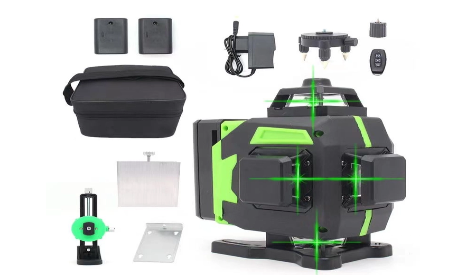
When choosing a 16 Cross Lines Laser Level, understanding the functional features is just as important as considering technical specifications. These features enhance usability, efficiency, and adaptability across a wide range of projects, from home renovations to professional construction. Key functional aspects include auto-leveling versus manual calibration, water and dust resistance, and tripod or mount compatibility.
Many modern cross lines laser levels offer auto-leveling, a feature that automatically adjusts the device to project perfectly horizontal and vertical lines. Auto-leveling minimizes human error, speeds up workflow, and ensures consistent accuracy across different surfaces. This feature is particularly useful for tiling, installing cabinets, or aligning multiple fixtures, as it reduces the need for repeated adjustments and careful manual measurement.
In contrast, manual calibration provides flexibility for angled or custom line projections. This is valuable for creative layouts, intricate interior designs, or specialty projects where standard horizontal and vertical lines are not sufficient. While manual adjustment allows for greater control, it requires a steady hand and careful setup to maintain accuracy. Users must be familiar with calibration procedures to avoid errors in alignment or measurement.
Durability is an important consideration, especially for construction sites or partially outdoor projects. Models with IP54 or higher ratings offer resistance to dust particles and water splashes, ensuring reliable performance under challenging conditions. A water- and dust-resistant laser level can withstand accidental exposure to moisture, dust, or debris, prolonging the life of the device and maintaining consistent accuracy in tough working environments.
Many 16 cross lines laser levels are designed for use with tripods or adjustable mounts. A tripod provides stable, consistent line projection across multiple surfaces, eliminating errors caused by handheld placement. Tripod compatibility is especially beneficial for large-scale projects, multi-plane measurements, or tasks that require precise alignment over long distances. Some models include adjustable tripods, while others can be mounted on standard supports, adding versatility and convenience for both DIY users and professionals.
When purchasing a 16 Cross Lines Laser Level, understanding the relationship between price, features, and intended use is crucial for making a smart investment. Prices vary widely based on accuracy, laser visibility, power source, durability, and included accessories. Evaluating your budget alongside project needs ensures you select a model that provides excellent performance without overspending.
Price Range | Features Included | Suitable Use |
Low-Cost ($50–$100) | Basic accuracy, red laser, limited range | Occasional DIY, indoor projects |
Mid-Range ($100–$200) | Higher accuracy, green/red laser, rechargeable batteries | Frequent home use, small renovations |
High-End ($200+) | Professional accuracy, auto-leveling, IP-rated, tripod included | Professional construction, large-scale projects |
Budget-friendly laser levels typically range from $50 to $100. These models provide basic accuracy, generally around ±2–3 mm/m, and use a red laser with a shorter visibility range. While they lack advanced features such as auto-leveling or IP-rated construction, they are perfectly adequate for occasional indoor projects, light DIY tasks, or small home improvements where precision requirements are moderate.
Mid-range devices, priced between $100 and $200, often offer higher accuracy, the option of green or red lasers, and rechargeable lithium-ion batteries for extended use. They may also include additional mounting options or improved visibility features, making them suitable for frequent home use, moderate renovations, or multiple simultaneous alignment tasks. This category provides a balance between affordability and functionality, offering both reliability and versatility.
Premium models above $200 are designed for professional applications. They feature professional-grade accuracy, auto-leveling, IP-rated dust and water resistance, and may include tripods or adjustable mounts. These laser levels are ideal for professional construction, large-scale renovations, or projects requiring high precision and durability. Investing in a high-end model ensures long-term reliability, maximum performance, and adaptability across various complex tasks.
Balancing your budget with required features allows you to select a laser level that meets your project demands efficiently. Carefully considering these options prevents overspending while ensuring you get a tool capable of delivering accurate and consistent results over time.
Before purchasing a 16 Cross Lines Laser Level, it’s essential to consider key factors such as laser accuracy, visibility, power source, functional features, and overall budget. Choosing the right model ensures precise measurements, streamlined workflows, and reliable performance for both home and professional projects. Whether you’re installing tiles, aligning cabinetry, or managing complex construction layouts, the correct laser level saves time and reduces errors. For expert guidance, high-quality models, and detailed specifications, visit Jsperfect. Their team can help you select the ideal laser level tailored to your specific renovation, creative, or professional needs.
Q1: Does the choice of laser color affect usability?
Yes. Green lasers are more visible in bright environments and at longer distances, while red lasers are adequate for standard indoor projects.
Q2: Is auto-leveling necessary?
Auto-leveling is convenient and reduces manual errors.
Q3: How important is laser accuracy?
Accuracy is critical for tasks like tile installation, cabinetry, or precise interior work.
Q4: Should I purchase an extra tripod or mount?
It is recommended to use a tripod or compatible mount for stability and precise alignment.


